





OHO Media International By Max Thompson, Senior Correspondent March 16, 2026
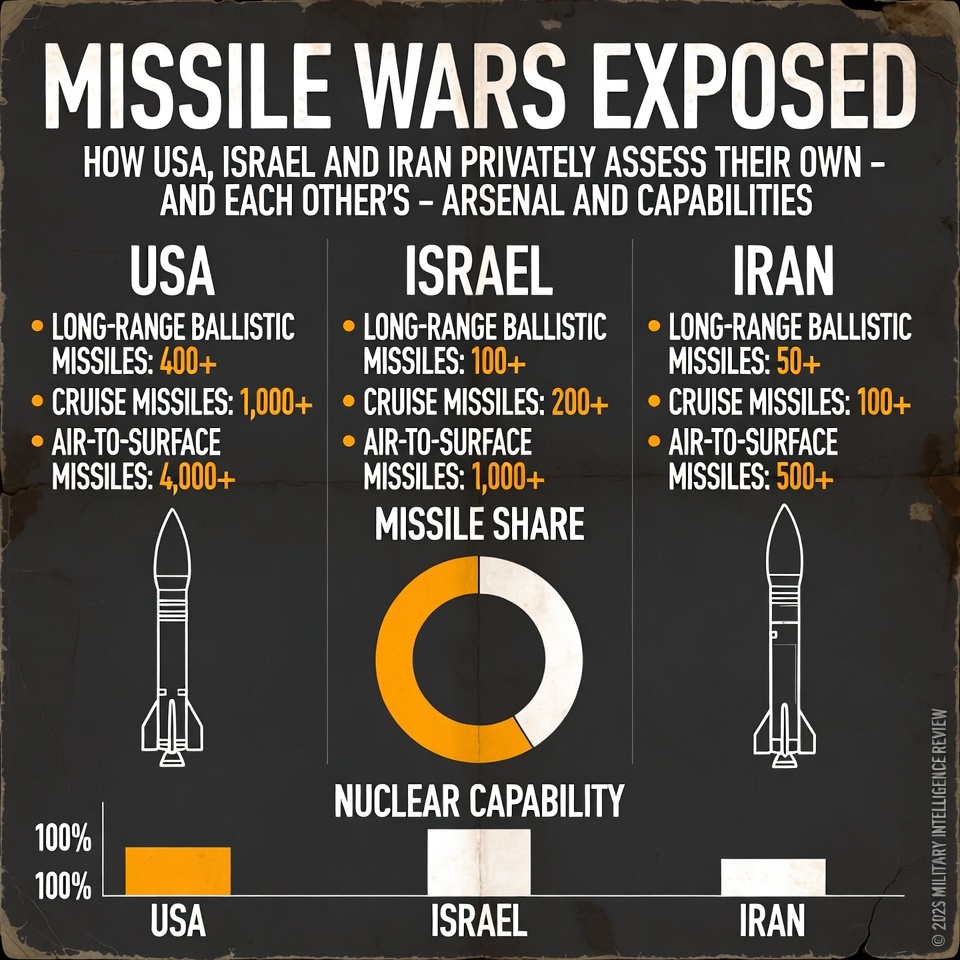
Four weeks into the conflict, all three main players have now released (or leaked) internal assessments of missile stocks, interception rates and overall military endurance. These documents – obtained through diplomatic cables, prediction-market leaks and statements from senior officials – reveal a surprisingly honest picture: no side believes it can win a long war of attrition.
1. United States Assessment (Pentagon & CENTCOM Internal Briefing, March 12)
Self-assessment:
- Current long-range strike inventory: ~4,200 Tomahawk, JASSM-ER and LRASM missiles remaining (down 38 % since Day 1).
- Interceptor stocks (Patriot PAC-3, THAAD, Aegis SM-3/SM-6): sufficient for another 3–4 weeks at current intensity, then “critical shortages” expected.
- Naval endurance: USS Gerald R. Ford remains at 45 % operational capacity; Abraham Lincoln limited to 60 % flight operations. Total US Navy losses in Gulf: 6 destroyers damaged, 1 frigate heavily hit.
Assessment of opponents:
- Iran: “Ballistic missile stockpile estimated at 2,800–3,200 operational units (down from pre-war 8,000+). Depletion rate 35–40 % per month. Accuracy improving but still only 22–28 % hit rate against moving targets.”
- Israel: “Iron Dome/David’s Sling/Arrow system performing at 78–82 % interception rate – better than our own models predicted, but interceptor burnout risk high by mid-April.”
Internal conclusion (leaked quote): “We can sustain high-intensity operations for another 21–28 days. After that we either need a ceasefire or must consider options outside conventional doctrine.”
2. Israel Assessment (IDF & Mossad Joint Estimate, March 13)
Self-assessment:
- Iron Dome/David’s Sling/Arrow combined interception rate: 81 % against Iranian ballistic missiles, 94 % against drones.
- Jericho-III missile reserve: intact and “more than adequate” for any retaliatory scenario.
- Civilian impact: 312 confirmed deaths, 1,800 injured – highest since 1967.
Assessment of opponents:
- Iran: “Remaining long-range ballistic inventory: 2,600–2,900 units. Production rate now only 40–50 missiles per week (down from 150). Anti-ship capability (Khalij Fars, Raad) remains dangerous – 18 % hit probability against our naval assets in the Red Sea.”
- USA: “US interceptor stocks are depleting faster than publicly admitted. We estimate they will reach critical levels 10–14 days before us.”
Internal conclusion: “If the war continues beyond April 10 without a pause, we face a 60 % risk of strategic exhaustion. A limited ceasefire is preferable to total depletion.”
3. Iran Assessment (IRGC & Supreme National Security Council Report, March 14 – partially aired on state TV)
Self-assessment:
- Operational ballistic missiles: 2,400–2,700 (down 65 % from pre-war estimates).
- Drone production: still 120–150 Shahed-136/238 per week – “our strongest remaining asymmetric weapon.”
- Naval losses: 70 % of surface fleet destroyed or damaged, but submarine and fast-attack boat force “largely intact.”
Assessment of opponents:
- Israel: “Iron Dome system at 79–83 % effectiveness – far higher than our pre-war models (we expected 55 %). Arrow-3 anti-ballistic system has neutralized 68 % of our medium-range missiles.”
- USA: “US Navy suffering real damage: at least one carrier at 40 % capacity, six destroyers hit. Their Patriot/THAAD stocks are burning at 25–30 % per week – faster than our missile expenditure.”
Internal conclusion (aired on IRGC TV): “We can maintain pressure for another 4–6 weeks. After that, production cannot match losses. The enemy is bleeding – but so are we.”
Bottom Line: Mutual Exhaustion
All three assessments agree on one uncomfortable truth: no side can sustain this pace beyond mid-to-late April without severe degradation.
- USA: running out of precision interceptors first
- Israel: running out of civilian tolerance first
- Iran: running out of long-range ballistic missiles first
This shared recognition explains why back-channel talks in Oman and Qatar have suddenly intensified in the past 48 hours.
The next 10–14 days will decide whether the war ends in a negotiated pause or collapses into a far more dangerous phase.
About The Author





More Stories
Happy Birthday, Christina Daous! 🎉
“Starlink Grid” – Is Elon Musk Building a Global Surveillance Network?
Global Oil Price Forecasts Amid the Iran–US–Israel Conflict (March 2026 Update – as of March 22, 2026)